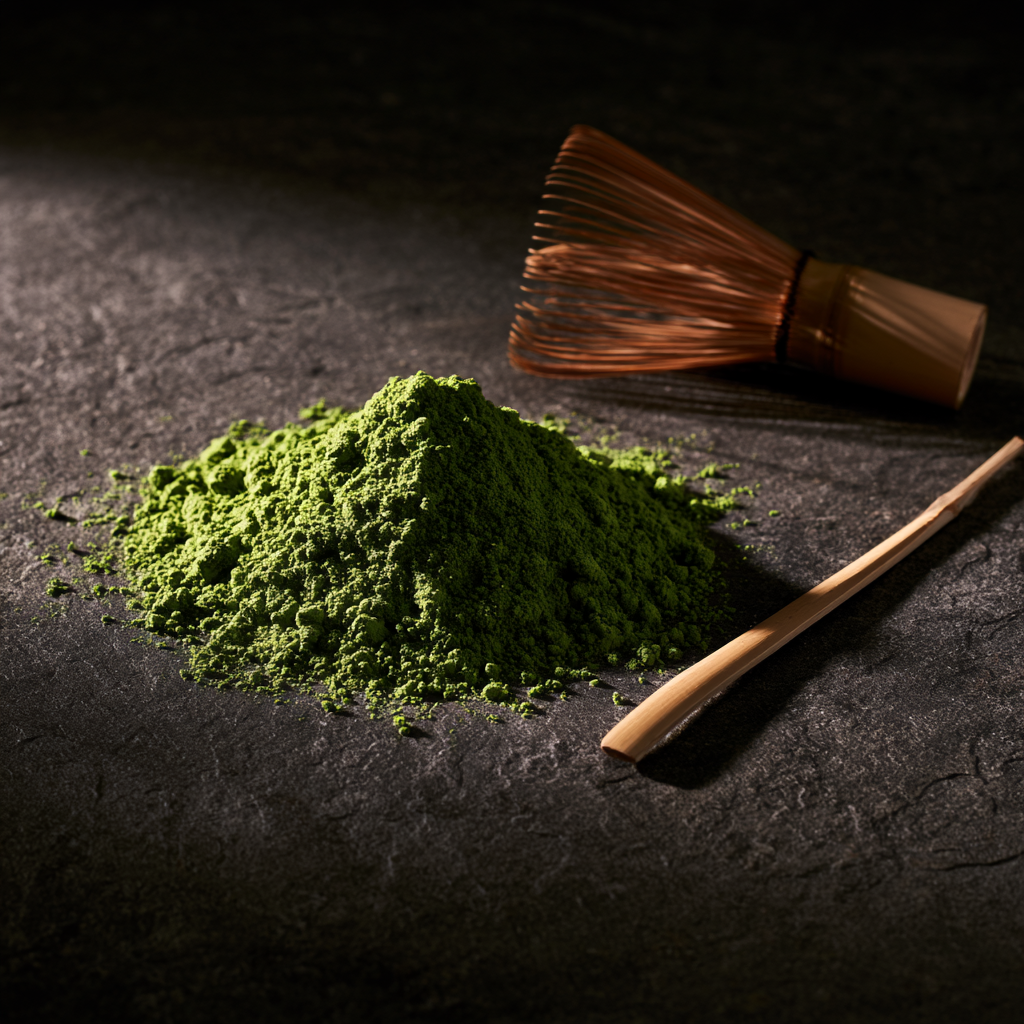


Matcha, sencha, hojicha, black tea.
All of them begin from the same single leaf.
What differs is only the path taken afterwards.
Every Japanese tea begins from the same leaf. What differs is the path it takes.

One Leaf, Many Paths
Every Japanese tea comes from the same plant — Camellia sinensis. The same leaf is steamed, rolled, roasted, ground, or oxidised, and depending on which process it passes through, it becomes an entirely different fragrance and colour. The map of Japanese tea is not a map of leaf varieties. It is a map of the paths that human hands have made.
One axis makes it clearer. Teas that are not oxidised are green teas — matcha, sencha, hojicha, genmaicha. The tea that is fully oxidised is black tea — wakocha. Leaves from the same field can become fragrances at opposite ends of the spectrum. That is what makes Japanese tea interesting.
The Map
| Tea | The path | Aroma and taste | MIOKA |
|---|---|---|---|
| Matcha | Grown under shade, steamed, dried, stone-ground | Deep umami and covered fragrance | SHINSUI・SENRO |
| Sencha | Steamed, rolled, dried. The essential form | Fresh astringency, sweet finish | HITOSHIZUKU |
| Hojicha | Sencha roasted at high heat | Toasty. Lower in caffeine | KOHZEN・KUNZEN |
| Genmaicha | Sencha blended with toasted rice | Toasty and light. Good with food | HOMIYABI |
| Wakocha | Withered, then fully oxidised | Gently sweet. Low astringency | WASAI |
* Every MIOKA tea is organically grown in Wazuka, Kyoto, certified under Organic JAS. For more on the land, see ORIGIN — Wazuka, Kyoto.
Five Paths
01 Matcha
For around three weeks before harvest, the field is covered to block sunlight. The leaves hold their umami and take on a distinctive fragrance known as ooika, the scent of shaded tea. Those leaves are steamed and dried into tencha, then ground slowly on a stone mill — the only tea in which you drink the leaf itself. Fragrant Okumidori in SHINSUI, and gentle Yabukita in SENRO. More in What is Matcha; how to whisk it, here.
02 Sencha
The most widely drunk tea in Japan, and its essential form. Freshly picked leaves are steamed to halt oxidation, then rolled as they dry, sealing fragrance and umami inside the leaf. Each time you pour, it unwinds a drop at a time — HITOSHIZUKU takes its name from that moment of concentration. More in What is Sencha.
03 Hojicha
Roast sencha at high heat and the astringent compounds soften while a toasted fragrance rises. Lower in caffeine, it is a tea that can sit with you at the end of a day. Leaf tea in KOHZEN, and powder for lattes and baking in KUNZEN. More in What is Hojicha.
04 Genmaicha
Sencha blended with toasted rice — the everyday tea of Japan. The toastiness of the rice lightens the tea's freshness, so it never competes with a meal. Unpretentious, and quietly lovely — HOMIYABI. More in What is Genmaicha.
05 Wakocha
Japanese leaves, fully oxidised — the black tea of Japan. Less astringent than black teas from elsewhere, and faintly sweet without sugar. The other face of a green tea country — WASAI. More in What is Wakocha.
Tea for Every Hour
If you're unsure where to start, choosing by the hour of the day is the most natural way.
| Morning, waking up | Matcha (SHINSUI) ・ Sencha (HITOSHIZUKU) |
| Midday, with a meal | Genmaicha (HOMIYABI) |
| Afternoon, a pause | Matcha (SENRO) ・ Wakocha (WASAI) |
| Evening, closing the day | Hojicha (KOHZEN ・ KUNZEN) |
From the same leaf, different hours are born.
A cup for each part of your day.
Fragrance Beyond Time and Borders.